Dave Sim and his fans and critics are going yet another round over the Cerebus creator’s attitudes towards women. I find it hard to get worked up over this issue -- Sim seems to be fairly isolated and so the only person likely harmed by his ideas is himself. Yet what does agitate me about his work is
all of the errors in it. His recent comic glamourpuss is loaded with proofreading problems; there's missing periods and misspelled words, and chronic inconsistency in the use of dashes, capitalization, possessives, and bold text.
This might not be important for some readers, yet I think it gets at a major problem with this comic and the production of alternative comics in general -- the lack of editorial oversight. Even more than artists, publishers and editors bear responsibility for this task. Their job is to present the artists in the best possible light: in other words, leave them alone when that benefits the work and make suggestions when it helps. Sim has no editor and proofreader (at least none are listed in the credits) and so does it all himself -- a noble goal, but in this case not the best choice. When I read comics by my favorite creators, I rarely find mistakes like this, and never to this degree -- they are obsessive types who pay attention to every detail. It’s also true that in a book of a certain length, it’s hard to avoid a few problems creeping in, even when you use a team of copy-editors. Yet a comic page typically has far less text than a prose page, so getting it almost free of these problems shouldn't be impossible.
You could argue, and you'd be correct to a large extent, that comics are different than prose, and therefore should not be subject to the same kinds of “rules” and expectations. In prose, for example, a sentence has some form of period-based punctuation at the end: ., !, or ?. But a sentence in a word balloon might not
and it can read just fine. The problem in general is one of communication and consistency. When the lack or (mis)use of punctuation leads to confusion/annoyance for the reader (the kind the artist doesn’t want), chances are something’s gone wrong. And the best reason to find and correct such problems is that a reader will stay focused on the comic and not be distracted.
If I were Sim’s proofreader, a quick count reveals around 90-100 things I would ask him about -- that's a lot for a 25 page comic (there is, granted, a lot more text on these pages than in most comics). Here are just a few of the problems as I see them in glamourpuss:
They begin on the cover: there’s no period in the last balloon.
Is this intentional? It looks OK to me, and had Sim been consistent in the book I would assume that it was intentional -- a strong artist can make any deviation seem right by the context in which it appears. The possessive of glamourpuss appears here as glamourpuss’ -- but on page 22 both glamourpuss’ and glamourpuss’s are used. Both of these forms are accepted (many prefer the latter), but why the inconsistency?
It doesn’t look to me like Sim is paying attention -- he seems to care far more about the art than the writing.
Periods:
I can’t find any consistency with his use of periods. Some sentences in caption boxes or balloons have them, some don’t. Some sentences outside of these have them, some don’t. This problem exists multiple times on nearly every page.
Dashes:
Sometime he will use 2 followed by 1: “word -- word – word”
Sometimes 2 by 2: “word -- word -- word”
A character’s name is spelled as Skanko and later as Skank-o.
Bold:
There's no consistency when he bolds an ellipsis.
He will do this: "word word word . . ." and the ellipsis is in bold.
And then "word word word . . ." and the ellipsis is not in bold.
Page 21: he writes “Beyond Noir Style” and then “Beyond Noir Style”
Quotes and punctuation:
Sometimes: “word.” other times: “word ”.
Production:
Part of a balloon is noticeably chopped off on page 24.
Etc . . .
And if this post seems pedantic to you, fair enough -- but comics are art too, and why not have high expectations or at least the same expectations as those you have for other art forms? I've never met a poet or fiction writer who didn't care about the details.
Wednesday, May 21, 2008
A Glamorous Life
Posted by
K. Parille
at
12:46 PM
1 comments
Monday, May 19, 2008
Volume 2
This October, Yale University Press will release the second volume of Ivan Brunetti's An Anthology of Graphic Fiction, Cartoons, and True Stories. From Yale: "The book presents contemporary art comics produced by 75 artists, along with some classic comic strips and other related fine art and historical materials. Brunetti arranges the book to reflect the creative process itself, connecting stories and art to each other in surprising ways: nonlinear, elliptical, sometimes whimsical, even poetic. He emphasizes continuity from piece to piece, weaving themes and motifs throughout the volume." The front and back cover feature art by Daniel Clowes, who provides three new strips for the dustjacket flaps. Here's a short interview comic by Brunetti about the book:
{Both images are from the amazon.com listing for the book}
Posted by
K. Parille
at
8:31 AM
2
comments
Thursday, May 8, 2008
Guitar Not Comics
This is the cover for a revised version of an instructional book I wrote that has just been re-released. I didn't come up with the title and the picture is not of me . . .
Posted by
K. Parille
at
12:20 PM
1 comments
Wednesday, May 7, 2008
Shamrock En Espanol

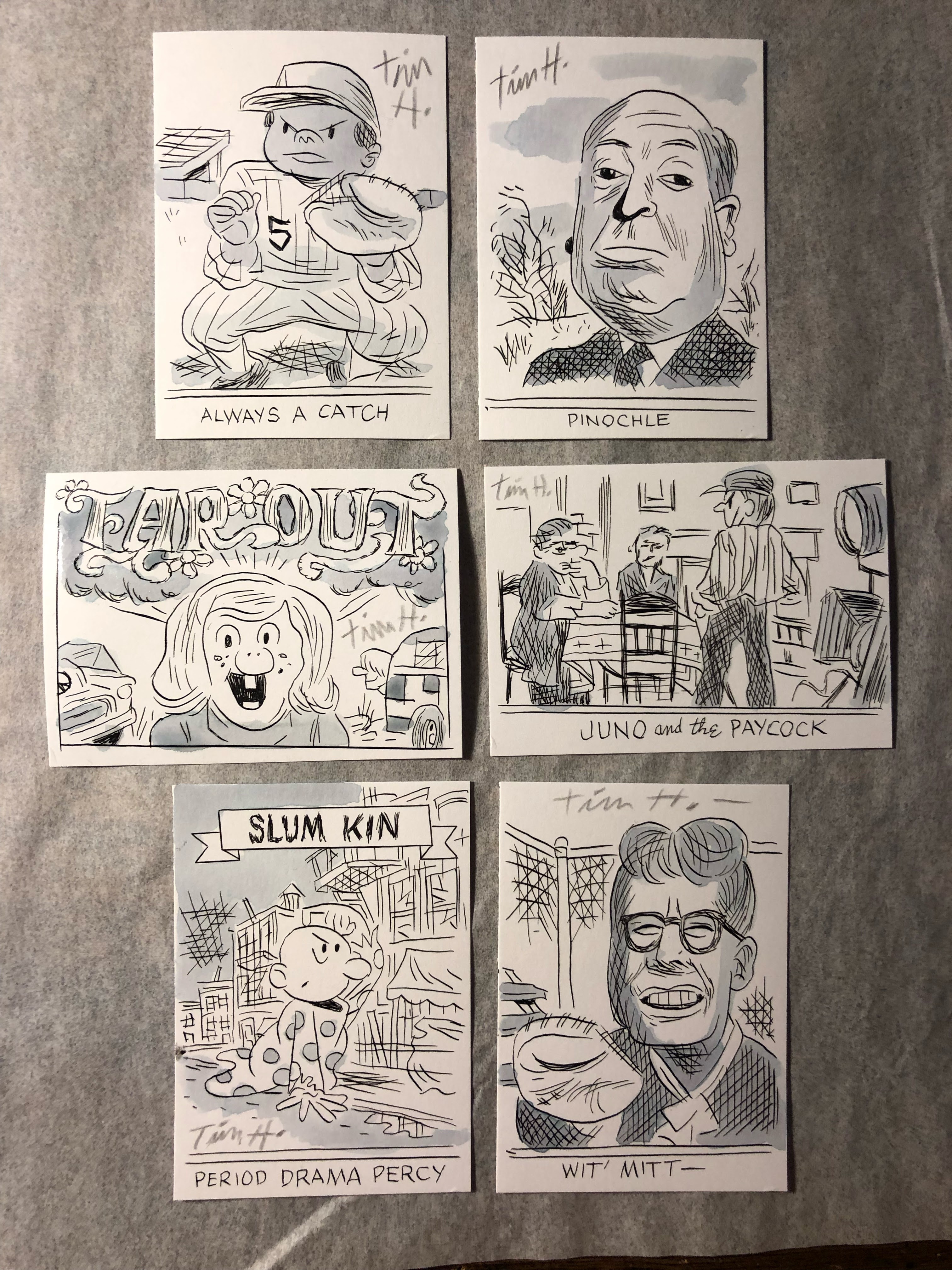
Recently I received out of the blue a copy of a Spanish edition of Mome in the mail, published by La Cupula. While I can only be awed and bewildered by the seemingly thankless effort involved in translating my work, I can also see how it must have proven difficult. In panel two, 'This be a sham reel" has become, near as I can tell, "This dance is pure theater." Also, "Stamps: They Can't Be Licked" has become, I think, "Stamps: Without Rival."
In the future, I suggest translating Mome as Momias...
Or even better perhaps, "Psychological Traumas from the Secret Archive of a Psychiatrist." I bought this historieta last year in San Diego mainly because of the box of Premium crackers in the upper right.
Posted by
Tim Hensley
at
1:16 PM
Tuesday, May 6, 2008
Clowes New Yorker Cover
Posted by
K. Parille
at
9:39 AM
0
comments
Friday, May 2, 2008
Wizard Top 200
Posted by
K. Parille
at
4:55 PM
2
comments
Comics: Art versus Action
Do you like fight scenes? I do, and Ted May's Injury Comics 2 has some of my favorites.
What makes the comic so unusual is the way it combines what could be considered a staple of art comics—autobiography—and a staple of mainstream comics—the fantasy action/adventure story. Jeff Wilson and May scripted the first of the comic’s two stories, “Hair of the Dog,” a tale of metal-heads, stoners, carnies, and failed romance based on Wilson’s teenage years during the 1980s and drawn by May, who wrote and provided layouts for the second story “Your Bleeding Face,” with finished art by Jason Robards. Continued from Injury 1, it features a cyborg named Manleau who takes on a gang of punks known as The Barnyard Animals. As Manleau and the Farmer brawl, the cyborg breaks out a number of his patented moves (at least I assume they are patented; they have names . . .):
The story has a lot of great pages like the one above; there’s a real interest here in creating layouts that change as the story moves from dialogue/conversations to action. Those who are interested in intelligent but not overly-clever layouts will find a lot to look at. The sci-fi inflected Manleau story is not a parody of or a self-conscious commentary on mainstream comics, but rather a straight-up action story done with a genuinely humorous approach (with many great jokes and puns) that I rarely see in Marvel and DC comics. I don’t want to spoil too much of the goodness, but here’s a tease of a panel plus a little extra that continues in the fight mode:
This story works well in the stapled comic book in part because it’s the type of ‘tale’ we have associated with this format since the 1960s. Also in that spirit, May’s information page reads a little a Stan Lee “Soapbox,” with funny descriptions of the stories and invitations for readers to write in with comments and to participate in a fill-in-the-word-balloon contest. And the back cover has a Kirby-flavored full-color drawing:
Yet, it would be wrong to think of this comic as a nostalgic throw-back; and “The Hair of the Dog” is certainly nothing like a Marvel story:
[Well, maybe Gobbie's "metal-sense," which tingles when the dudes crank up Witchfinder, is Marvel-esque.]
And, for no particular reason other than I like it, here's a great series of expressions from "Your Bleeding Face," especially the one on the Veronica-inspired character Pig:
The comic contains over 40 pages of story in crisp black and white, beautiful color covers, and no ads. A more detailed preview can (and should) be checked out here. It’s refreshing to read a comic whose only pretense is to entertainment and yet is so intelligently done that it encourages re-reading rather than a trip to the long-box to file it away.
[Disclaimer: I was involved in a small way with the production of this comic--so that makes this post not a ‘review’ as much as a little ‘boosterism’ for a comic I really like.]
Posted by
K. Parille
at
9:45 AM
2
comments
Saturday, April 26, 2008
Influence?
On his blog, Rich Tommaso recently posted about his comic Miriam and notes that people often accuse him of "ripping off" Daniel Clowes. In response to such claims, Tommaso says that he has changed from inking with a brush to a pen. When I first read Miriam last fall, I enjoyed the comic yet noticed what seemed to me like similarities to Clowes's work. It wasn't that Tommaso's ink line looked like Clowes, but rather that scenes in Miriam echoed moments from his comics. In the post, Tommaso invites readers to "tell me what you think: Am I still ripping off Dan Clowes?" I am taking this question as genuine and assuming that Tommaso wants it discussed; so in what follows, I post images from the two cartoonists. Tomasso's panels are not swipes, but they show, I think, the influence of Clowes, especially in terms of characters and plot. You can look at this series of images and decide for yourself the degree to which they do or don't echo Clowes.
In Miriam, a former cameraman, now an alcoholic, waits on a couch to be interviewed by a film school student:
In a still from Art School Confidential, a former artist, who is also an alcoholic, sits on a couch and talks to an art school student:
Miriam and Ghost World's Enid have similarly unusual names, body types, and facial features, wear interesting glasses, talk on the phone in various states of undress etc . . . 
A similar moment in Miriam and Ghost World:
No one’s home, and a girl provides a “wisecrack”:
The young Miriam is a little like a visual amalgam of three Ice Haven characters: the fuzzy coat of David Goldberg; the glasses and bug-eyes of Charles; and the stuffed toy of Georgie. Enid also likes the Flintstones and has a Fred Flintstone and Pebbles doll:


A parent attempts to get a child to play with an unwilling participant - Miriam then Ice Haven: 

A similar street scene in Miriam and Clowes's The Death Ray:

This image is like the two that follow, from Clowes's Caricature and the cover of Eightball 15:


Similar establishing shots:

A moment framed by a window:

On the phone while on a bed:
Miriam makes use of a standard Clowes style of lettering – the Clowes in color is from the GW cover:

Some full pages of Miriam can be seen here.
Here's a review that discusses this topic.
Posted by
K. Parille
at
11:19 AM
17
comments
Labels: Clowes, Side by Side, Tommaso
Sunday, April 20, 2008
The Triumph of Dr. Payn

Much of the language used when generalizing about Fredric Wertham seems to come from comics itself – many attack the psychiatrist as a “villain,” and others celebrate him as a “defender of children.” And the value of Wertham’s 1954 study Seduction of the Innocent is often reduced to a pro-con argument over its findings about the harmful effect crime comics had on readers. One thing that such an argument misses is a fuller appreciation of Wertham’s wide-ranging approach to reading and understanding comics.
When I first read SOTI, I was taken by how comprehensive Wertham is. He doesn’t just talk about plots and images, but rather he looks at numerous aspects of the comics, their production and dissemination, writings about them in the press and in the educational community, and the responses they generate in readers. It’s true that he presents these things in a fairly scattershot and repetitive manner, but the scope of his interpretive agenda is impressive. Here’s a quick and incomplete survey:
Reader Response:
Wertham talks in detail about children’s readings habits: how many comics they read and the way in which the high rate of circulation of current and back issue among friends affects readership numbers. He also explores the effect of comics on literacy and the different ways in which children of different ages read – or don’t read – the words and focus on the meaning conveyed by pictures. He and his staff interview readers and he connects their responses to their “reading grade,” intellectual abilities, and social conditions. He also discusses children’s fantasy lives and talks about parents’ beliefs about children’s reading habits . . .
The Comic and Meaning:
When he looks at the comics he talks about typography (which words are set in what size type), the material they are printed on and its cheapness, how they are colored, the kinds of plots they share, recurrent character types, the kinds of splash pages they feature - and in each case he talks about what this means. He looks at the relationship between advertising and story content (especially ads having to do with the boy and girl readers' masculinity/femininity and self-image), the way comics feature sexually-charged “pictures within pictures,” the relationship between the repetitious nature of comics and their disposability – how they create a desire to read more. He does numerous short close readings of various scenes and whole comics and discusses where and how the publisher's defenses of the moral value of their books are placed in each pamphlet. Wertham also does his own (and discusses others’) quantitative studies of comic: what types of actions appear and how many times etc . . .
Production:
He looks at publishers' methods and intentions, the ways they defend their product (in the comics and in the press) versus what is happening in the comics themselves. SOTI studies their circulation numbers and looks at the names of companies and how producers represent themselves in the indicia as a way to conceal who is creating what – (he notes one company will use many names, for example). Wertham also talks about the artists who create the books and their motivation for doing so . . .
Social Contexts:
His readings range extensively, covering important issues such as race, gender, sexuality, class, adult-child and sibling relationships and how these issues play out in the lives of characters and readers, and in the culture at large . . .
Cultural Reception and Reaction:
The book examines dozens of arguments about comics and children in the popular press as written by parents, educators, social critics, and medical professionals -- and Wertham puts these arguments in the context of trends in child development and behavior and his own readings of the comics . . .
Comparative:
He defines his subject by talking about the ways they echo or deviate from other forms of entertainment: non-crime comics, comic strips, children’s books, adult fiction, movies, classic comics and the literary classics they adapt. . .
I can’t think of any other study on comics that pulls from so many different methods to make its claims. Because of this, put me in the pro-Wertham camp; it's hard not to appreciate someone who takes comics so seriously and from so many perspectives: psychoanalytic, ethical, literary, political, sociological, material (objects and production), reader reception/response . . . He may be comics' most wide-ranging critic.
{Apologies for the bad scans - but I wanted to show the images that Wertham uses and his commentary on them -- and the book's binding often gets in the way of a flat scan.}
Posted by
K. Parille
at
12:33 PM
0
comments
Reminders
Leon Beyond: new strips by Ted May, Kevin H., and Dan Z. are here.
Jordan W. Lint: Part 2 of Chris Ware's serial is in the latest VQR. It's a comic-friendly issue, with a cover by Art Spiegelman, a comic by Ross MacDonald, and an essay on cartoonist Rory Hayes by his brother, Geoffrey.
Posted by
K. Parille
at
12:31 PM
0
comments
Friday, April 11, 2008
Room 26 Cabinet of Curiosities

Take a look through the Room 26 Cabinet of Curiosities, a great blog best explained in their own words:
Room 26 Cabinet of Curiosities features new acquisitions, unique documents, and visual and textual curiosities from the collections of the Beinecke Rare Book and Manuscript Library, Yale University. This ongoing exhibition is curated by Tim Young, Associate Curator of the Modern Books and Manuscripts Collection, and Nancy Kuhl, Associate Curator of the Yale Collection of American Literature.
Among the interesting work they feature you'll find: The Real adventures of Tintin, and this fun and beautiful piece of ephemera: The Test Flight of Sky Robin.
Wow, there is just too many incredible things shared at that site.
Click below to see a random sampling of stuff you will find in the archives.


Posted by
J. Bennett
at
11:46 AM
1 comments
Monday, April 7, 2008
Tomine's Scene
Had it been widely available, Adrian Tomine’s 2007 mini comic Scenes from an Impending Marriage likely would have made its way onto many best-of lists.
Scenes features a stripped-down approach to storytelling in a simply designed, attractive book, two hallmarks of Tomine’s work. It includes six strips (each is 1 to 4 pages) and two single-panel full-page gags, all of which narrate humorous moments as Tomine and his then-fiancĂ©e-now-wife, Sarah, prepare for their wedding. They almost hire a DJ, who gives them some CDs so they can “get a sense of his flow,” but they’re not feeling it; they visit a salon, where Adrian supportively comments on—and according to Sarah, tries to decide upon—her wedding-day hair style. The couple also undergoes the “bizarre ritual” of registering for wedding gifts; and they negotiate their two families’ request for different kinds of traditional ethnic entertainment.
In the indicia Tomine writes that “some of the characters and . . . events . . . are fictitious, or at least highly distorted for the sake of clarity and/or humor,” reminding us that, as with all autobiography, Scenes should not be taken literally, though it’s fun to do so. And Tomine’s work, like that of many artists I like, is often far funnier than it's given credit for. And his sense of humor is on full display here. The comic is only 16 pages, but Tomine packs a lot of comedy into the small 6-9 panel grids, making it feel far longer, like a typical full-size comic book. When I talked about the comic with someone who had read it, he recalled it being around 30 pages . . .
Tomine takes a looser approach in Scenes than he does in recent work like 2007’s Shortcomings where, for example, each panel shows a high level of detail, with backgrounds that are meticulously drawn:
The comic features a polished version of the style that Tomine uses for strips in his sketchbook, as in this one from his 2004 collection, Scrapbook
and it has an incredibly appealing breezy and minimal visual look that’s cute and almost delicate, with a thin and relaxed, natural ink line (the only straight lines to be found are the panel borders).
And its cartoony-ness is a little like that of Tomine’s recent New Yorker cover
or in his story The Donger and Me, which first appeared in Giant Robot a few years ago and more recently was posted on NPR’s webpage:
As in Tomine’s other comics, what stands out in Scenes is the way he connects facial expressions and body gestures, though here they have more of the exaggeration typical of newspaper comic strips (a few panels show a clear debt to Peanuts). In one scene—a phone conversation with the almost-hired DJ— Sarah’s facial expression changes slightly from panel to panel—the eyebrows shift slightly, the head moves up or down, she bites a fingernail then a thumbnail, and the gentle comedy of the visuals matches the quickly shifting rhythms of the conversation’s ebb and flow. There’s a lot of charming self-deprecating humor, as in “Poor Us,” where Tomine draws attention to the couple’s narcissism as they obsess over problems with the wedding and honeymoon plans. This story, too, shows Tomine’s skill at cartoon gestures; it includes a perfectly executed nine-panel sequence of distinct poses that ends in a great moment of Peanuts-esque self-pity.
In the mini comics tradition, each copy (a few hundred were made) was hand-assembled, and in a way it’s a throwback to Tomine’s roots, as the early numbers of his series Optic Nerve were assembled and self-published (Tomine recount his self-publishing history in the introduction to his mid-'90s collection 32 Stories). But the fact that this comic was self-produced in a short period of time shouldn't mislead us. It’s the polished work of a confident and sophisticated cartoonist who knows how to work to great effect with an economical visual style and a compressed narrative sense.
All in all, a perfect mini comic.
A few panels from Scenes:

The Shortcomings Site
The "Donger and Me" at NPR.org
Tomine Interview at The Believer
Tomine's Official Site
Posted by
K. Parille
at
1:13 PM
6
comments
Monday, March 31, 2008
Al Jaffee and his MAD Fold-Ins at The New York Times.

The New York Times has a feature on Al Jaffee with a really nice interactive collection of MAD Fold-Ins.
Posted by
J. Bennett
at
11:31 AM
0
comments